Getting Started With Long Term Care Insurance

All insurance is a way to hedge your money.


Most people choose to purchase long term care insurance because they have known someone who has needed long term care and that experience convinced them of the importance of protecting themselves, their family and their assets.

LTC Insurance is like health insurance, it's for a really big events, the kind that could cause you to use up all your savings and assets.

People who haven't personally experienced or had to watch life savings disappear paying for long term care think that long term care insurance is expensive. The truth is that it's not cheap but still pennies on the dollar compared to the out-of-pocket cost of long term care.

"The #1 fear retirees have is the fear of running out of money."
Forbes Magazine


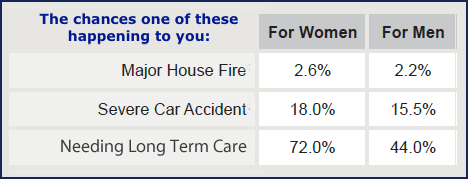
On the National Insurance Institute chart "Risks You Face Every Day" you saw how much of a risk you have with long term care. Insurance is based on risk and professional actuaries determine premiums.

But why the high premium? You have about a 1 in 1300 chance of your home being destroyed and because of these odds homeowners insurance averages $730 a year. How much would homeowners insurance cost if the chances of your home being destroyed (1:1300) were the same as your chances of needing long term care (1:3)?

Because the odds are at least 1 in 3 that you (and spouse) will need long term care you should either set aside an average of $200,000 for care ($400,000/couple) or you can buy insurance. Either way you are going to need care and either way you are going to pay for it.

Why People Buy Long Term Care Insurance?

Here are six most common concerns about long term care and the reasons people buy long term care insurance:

  1. Burden - Do not want to be a financial or emotional burden on others.
  2. Access to quality care - Being able to select a quality facility in a location of my own choosing.
  3. Aversion to welfare (Medicaid) - Not wanting to be dependent on the government for care.
  4. Asset protection - Preserve assets for healthy spouse, inheritance for children or donation to charity.
  5. Control and independence - I want to maintain personal control in the choices I make.
  6. Peace of mind - Knowing I am protected instead of worrying about what could happen.

  7. Complete this sentence: "My biggest concern about my care is..."

< Click to take a LTC Concerns Survey >

If you haven't had firsthand experience with someone needing long term care you may not have fully experienced the impact that long term care has on a family.

If you not yet protected yourself with long term care insurance either you do not know about it or maybe you have been just hoping that it won't happen to you.

If you're over 65 then so far you've been lucky, you might say that the sun has been shining on you!


On the other hand a storm may be nearby, so just keep reading, because the more you know, the more informed a decision you will be able to make.

(Article linked: We're in mass denial of long term care reality)


Do I Need Long Term Care Insurance?

The majority of people are not aware of the likelihood of needing long term care. The following questions can help you determine whether you may need the protection provided by long term care insurance.

1. Can you afford to use your savings or retirement income to pay for long term care at $150-$300 per day?
2. Do you have assets excluding your home that are at risk?
3. Has anyone in your family ever needed long term care?
4. Would taking care of you be an emotional or physical hardship for your spouse/partner?
5. If your spouse/partner needed long term care, would you be able to provide it now and when you are older?
6. Would the people caring for you be able to maintain the quality of their own lives?
7. Are you concerned with being able to afford long term care?

If you answered "yes" to two or more of these questions you should consider long term care insurance.


Am I Too Old, Or Too Young For Long Term Care Insurance?

Often what prevents people from insuring against the high cost of long term care is the cost of the premium.

Even though the younger you are the cheaper long term care insurance is, if you are older and can health qualify then long term care insurance will still be pennies on the dollar less than paying yourself.

If you are younger and your comprehensive policy costs $2,000/yr, and you paid for 30 years, that's $60,000.

If you are older and your comprehensive policy costs $5,000/yr, and you paid for 12 years, that's $60,000.

If you paid for care yourself $60,000 would only cover about 9 months of care at today's rate!

People who balk at paying $2,000-$5,000 a year for insurance are risking having to pay $5,000-$9,000 a month for care -- as Mr. Spock would say, "that's illogical."

What if you needed 4 years of care? Where would the $200,000+ come from?

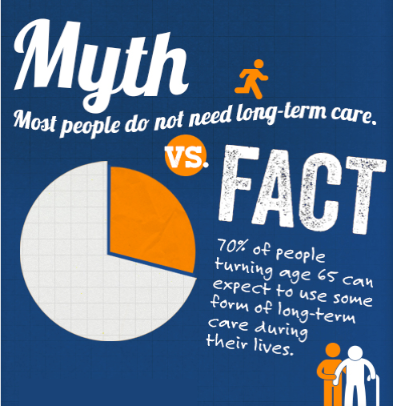
The U.S. Government Accounting Office and The Wall St. Journal recently reported that as many as 60% of all Americans will require some long term care because we're living longer which makes needing long term care more likely.

So you are basically saying to your kids, "rather than insuring, I'm risking your inheritance, and by the way you'll also have the burden of caring for me."

Nearly half of people over age 65 will have at least one stay in a nursing home.
New England Journal of Medicine


Single people living alone are often the most needing of assistance at home. Most health insurance and Medicare/Medicaid provide very little if any at home care.

Some long term care insurance plans have a waiting period (deductible) before you can claim benefits for home care. Often the most needed time for assistance is at the beginning. This recovery time can be even more difficult for a single person.

If you choose a policy with a home care deductible make sure you have a plan to cover the waiting period by either paying for care yourself of having unpaid help like a friend or family member.

More people get turned down because of health reasons than for financial reasons. If someone doesn't health qualify they are now on the path to self-pay.

Sometimes if one spouse cannot qualify for long term care insurance they both won't want the insurance. They are just reacting to the one spouses rejection.

How does that make sense? If one spouse loses their car insurance does the other spouse stop their car insurance? The situation is that if only one spouse can be insured then the money can be used for the non-insured spouses long term care.

Often if one spouse has insurance and the other doesn't and needs care they are very relieved that they have some protection. They might need all the money they have left after paying for care to stay out of financial trouble.

Unlike many people who can't qualify for insurance you might be lucky enough to have the choice to either spend $200-$500 per month for insurance rather than $4,000-$9,000 a month for care.


You don't buy long term care insurance for you, it's for your family.


Here is something that insurance companies wouldn't necessarily want you to know about or do. Even if one spouse does have health issues that may disqualify them, not major health problems like Parkinson's or a stroke, they should apply anyway. That way the spouse that gets insured will in most cases still be able to get the couples discount or a partial couples discount.

Similarly some companies give couples discounts to any two people who are of the same generation and share living expenses may qualify for the substantial couples discount. They could be friends, lovers, siblings, domestic partners, etc. You can email us if you have questions about this.


"Considering that the average cost of nursing home care is approximately $70,000 a year, and home care costs can range from $50 to more than $200 a day, long term care insurance makes a lot of sense for millions of Americans."
- Chicago Tribune


Top of Page

Although it might be better to ask what could not having long term care insurance could cost we do understand that everyone wants to know how much it will cost them to insure. We have a sample premium rate page here.

Since State requirements are different and each persons needs are different the only way to know what your individual options are is to talk with one of our advisors by phone or email. You can first get a personal quote and the advisor will explain the quote and your options. With this comprehensive quote you should be able to determine if this insurance is affordable and appropriate.

Premiums are based on your age, and two benefit factors (benefit amount, benefit term). If you have a health issue you may not be able to get insurance of may have to pay a higher premium.

Generally companies offer benefits ranging from $50 to $400 a day ($1500-$12,000/month) and benefit terms for 2, 3, 4, 6, years. Some offer unlimited or lifetime benefits.

If you buy a lifetime or unlimited policy you will receive benefits for your lifetime. Unless you have Alzheimer's in your family or other health issues that require a long period of care, insuring for unlimited is more than what most people will need. But there are some people that never want to think about running out of benefits, this works for them.


Everyone Has Insurance
They're either self-insured or have a LTC policy.


If you buy anything less than unlimited/lifetime then you will have a certain amount of money available for benefits. We'll call this your long term care pot of money.

Here is an example of an average premium calculation: At age 50 with a benefit term of 3 years (36mo) and a *48 rate multiplier. Multiply the *48 rate times a desired monthly benefit of $5000, divided by 100 ($5000/100) or 50 and your annual premium is *48x50= $2400. ($6000/mo benefit premium would be 48x60=$2880)

This $2400 annual premium provides you on the first day of being insured with a "pot of money" of (36moX$5000) $180,000. At age 50 you would want a compound benefit increase which would double the "pot of money" to $360,761 (or $10,000 per month) in 14.25 years (when you're 64).

Long-term care insurance could be seen as an investment because of the almost certainty that you will need long term care. But do the numbers back this up? Find out here.

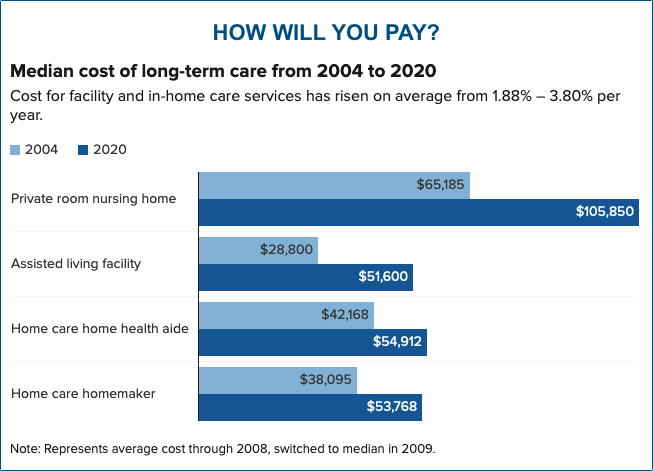
The cost of long term care can double every 14 years, so $200/day today will be $400/day then. If you have $200,000 set aside for care today will it double in 14 years?

Do you think you can invest and do better? Some people think so, in fact even some financial advisors think so.

Why wouldn't they? They get paid to invest your money not when you buy insurance. But they're short-sighted because statistically almost half of their clients will need long term care and pay for it by spending down their "assets under management."


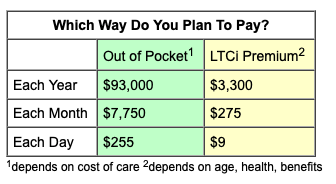
Have you decided to pay $72,000 a year
rather than $3,000 a year?


Given the high risk of needing long term care, would you rather spend $3,000 a year (insurance) or $6,000-$10,000 a month of your savings for long term care? The national average for nursing home care in 2006 was $72,000.

If someone had the choice between spending $72,000 a year for long term care or $5,000 a year for insurance, what they do more often than not is choose the $72,000 by self-insuring.

With the odds at 50:50 of needing at least 2 years of long term care it's not logical to choose the $72,000 over the $5,000, but then again studies show most financial decisions are not made with logic.

There is also a ceiling at which most people balk at buying insurance even at a 50:50 risk and that ceiling is about $3,000. Even though we have a few with policies that are double and triple that the majority are under $3,000. For a couple that would be $6,000 a year. For many people that's a lot of money, and if they don't insure they must make other plans, today.

If you are considering long term care insurance you also need to consider inflation protection, an option with most commercial insurance coverage.


Generally long term care insurance policies are sold with either Equal or Compound inflation protection.

Equal also called Simple inflation protection means that the benefit amount will grow by a fixed amount each year based on the original amount.

With Compound protection the benefit amount will grow by an increased amount each year based on a percentage of the benefit amount (compound increases). A policy with Compound protection is a little more costly than Equal but provides an annual increase in the benefit amount greater than Equal protection.

As you can see by the charts below, after about 10 years Compound starts to increase more than Equal. Using as an example a $5,000/month 6-year policy in 10 years the policy is now paying out Equal $7,500/mo, Compound $8,144/mo, the difference is $46.368. Continuing to 15 years Equal is now $8,750/mo, Compound $10,394, and the difference is now $118.368.

Which is best for you? It depends on your age, health, family history, and your goals. A rule of thumb is for those under 70 should consider compound inflation protection.

Ages 70-75 should consider simple inflation. No inflation protection premiums are less expensive and should be considered by those over 76 years of age or if you are comfortable with the future possibility of having to pay the difference between your daily benefit amount and the actual cost.


Also see Personal Benefit Account Chart


National Average Nursing
Home Costs in 2000
Estimated Costs in 2010
(based on 5% inflation)
$153 per day $230 per day
$4,667 per month $7000 per month
$56,000 per year $84,000 per year

Top of Page

If you're thinking about waiting to purchase coverage, consider the impact that time has on the cost of this insurance. Each year you wait can cost you more money. Premiums are based on age and benefits. As you age your risk of needing long term care becomes greater. The longer you wait to insure yourself for long term care, the greater the total cost can be.


What is the Cost of Waiting to Purchase Long Term Care Insurance?
"For many, it may make sense to purchase long term care insurance when they're relatively young, because the sooner they start, the lower the premium they pay...A better reason to begin early is that changes in your health may prevent you from buying it later."
- Chicago Tribune

An example of the Cost of Waiting:

Age Today Plan Today Annual
Premium*
Total Premiums
if Paid to Age 80
Cost of Waiting
5 Years*

$33,200

55 $130/day
1460 Lifetime Max
90 Days (Wait Period)
5% Compound Inflation
$2,160 $54,000
($2,100 x 25 years)
Age in 5 Years Value of Original Plan
after 5 Years
Annual
Premium*
Total Premiums
if Paid to Age 80
60 $160/day
(5% annual compound
inflation protection)
1460 Lifetime Max
90 Days (Wait Period)
5% Compound Inflation
$4,360 $87,200
($4,360 x 20 years)
* Premium examples do not include any discounts or riders.
* Premiums for a 60 year old will unlikely be the same in 5 years as it is today.
* Companies introduce new policies with higher rates every few years.
* Larger companies like Genworth have a history of not raising rates once your insured.
* There also may be a pre-existing condition in 5 years that would make you ineligible for insurance.
* It will never be any cheaper to get long term care insurance and you are locking in your health.
* 1460 (days) is how much coverage is for at maximum payable benefit. Standard periods are 2 year (730), 3 year (1095), 4 year (1460), 6 year (2190), and lifetime or unlimited.
* $130x1460=$189,900 -- with interest compounded for 5 years increases to $160x1460=$233,600 and so on.
* 90 Days Elimination Period is the deductible time you pay before benefits start. See policies for actual coverage for each plan for each company.


You Can Afford A Long Term Care Insurance Policy

Can you afford a long term care insurance policy? Can you afford to self-insure? Most people buy a long term care insurance policy to protect their nest egg/retirement money so they can have a good retirement and leave something for their children. A common way to pay is to use some of the return on investments.

Of course the more in your Nest Egg the more you risk spending when self-insuring.

Why self-insure long term care when you don't self-insure your health, car, home, boat, etc.

Financial planners often will give clients a choice: either buy long term care insurance to protect their assets or set aside $100,000-$200,000 for long term care expenses.

Download this section : How ROI Can Fund LTC Insurance.pdf

If you are a financial advisor read this information.

What to Look For in a Long Term Care Insurance Policy

A long term care insurance policy helps put you in control when you need it most - by helping to protect your assets and to ensure that you receive quality care in the setting you want. That's why it's so important to select a policy that's right for you.

A good plan design when judging policies is the National Association of Insurance Commissioners' (NAIC) model laws and regulations, which recommends:

* At least one year of nursing home or home health care coverage, including intermediate and custodial care. Nursing home or home health care benefits shouldn't be limited primarily to skilled care.
* Coverage for Alzheimer's disease.
* An inflation protection option.
* An "outline of coverage" that systematically describes the policy's benefits, limitations and exclusions, and lets you compare it with others.
* A guarantee that the policy cannot be cancelled, non-renewed or otherwise terminated because you get older or suffer deterioration in your physical or mental health.
* The right to return the policy for a full premium refund within 30 days, if after having received the policy, you decide you don't want it.
* No requirements that policyholders first:
* Be hospitalized in order to receive nursing home benefits or home health care benefits.
* Receive skilled nursing home care before receiving intermediate or custodial nursing home care.
* Receive nursing home care before receiving benefits for home health care.

Also, be sure to consider the company behind the plan. Look at its track record in terms of experience in long term care insurance, as well as its ratings and financial stability.

When researching for a long term care insurance plan you want one that requires only two (2) ADLs to trigger benefits for home, community, or nursing home care. Some plans, especially group plans require three (3) ADLs for nursing home benefits to be triggered. This means you may have to wait a lot longer before the insurance pays.

We will be glad to work with you to design a plan just for your needs. We have years of experience and work with the top long term care insurance companies. To get started, get a quote.

California residents have an option called The California Partnership for Long Term Care. More about that here.


Not All Long Term Care Insurance Is The Same

The old adage is still true here: "if it's too good to be true it probably is." The top long term care insurance companies are similar in plans, benefits and even premiums. What distinguishes them are their underwriting guidelines and how they are structured to pay benefits.

The stricter the health guidelines, the healthier the client, the less likely a rate increase will be needed in the future. Some companies and group plans have had multiple rate increases for policyholders. This makes it hard for people to plan retirement expenses.

Why would someone buy a policy from other than the top insurance companies? It could be that the company is selling at an attractive lower premium rate to gain market share, with almost certain rate increases later. In some cases a person cannot health qualify with a better company and needs to look elsewhere for coverage.

If you cannot qualify with one of the bigger/better companies you may qualify for a policy with a company that offers fewer benefits with higher premiums and probably has a history of rate increases.

This doesn't mean you shouldn't consider the insurance. You just should look carefully at what they are offering you. You can also call your state office of insurance and inquire about the company.

You still may end up saving tens of thousands of dollars even with a lower rated companys policy. But if you are in fairly good health there is no reason to buy a lower rated company or even a group policy, both of which have higher deductibles with lower benefits.


(get a Genworth insurance quote today)

The above chart shows the size of the company and it's management philosophy. In the New York Times article of March 26, 2007 four companies were criticized for claims issues; John Hancock, Conseco, Bankers Life, and Penn Treaty. Their denials were disproportionate to the number of policyholders filing claims.

Policyholders have filed thousands of complaints against companies such as Conseco, its affiliate Bankers Life, Penn Treaty and John Hancock Insurance Company. Penn Treaty received one complaint for every 1,207 long term-care policyholders -- compared with Genworth Financial, the largest long term-care insurer that received only one complaint for every 12,434 policies.

The reasons for denials can be legitimate or not. A legitimate claim denial should not only be obvious but easy to understand the reasoning. For example if you didn't have flood insurance and your house flooded your fire insurance won't cover it.

You should know what is in your policy, what the deductible, benefits, exclusions, limitations, benefit eligibility, conditions, care and services definitions, and rate increase history.

All companies have this information available to you. Some have a "sample policy" or an "outline of coverage" that is that is available by request.

Don't be scared off buying long term care insurance because of a few bad apples. There are companies with the right management philosophy so you can feel comfortable buying from them and you will be able to count on them to be there in 10-20-30 years from now.

Policy Cost Comparison*
. 40 yrs 50 yrs 60 yrs 70 yrs
Genworth $2007 $2116 $2885 $6494
John Hancock $2024 $2208 $3293 $6127
MetLife $1987 $2264 $3045 $6183
*based on same age with similar plans,
your situation may require a different plan.


Tax Deductions For Long Term Care Insurance

If you're the type that spends weeks or months looking into how to pay for long term care insurance you are putting the cart before the horse.

If you had a stroke tomorrow would it matter how you're paying or would it matter that you're insured?

First get insured then look at how to pay for it, whether annually with a check, monthly automatic withdraw, a SPIA, a MSA, and the tax incentives.

That said, you should consult with your accountant or tax advisor about any tax consequences regarding long term care insurance. Some states have tax incentives some do not. Here's a list.

Long-term care insurance may be tax deductible depending on various factors. These include whether you are an individual, a partnership, a sole-proprietorship or a corporation. Some deductions are subject to age-based eligible amounts which are increased to allow for inflation. (see IRS Long Term Care)

The most common policy is a "tax qualified" or TQ plan. NTQ or "not tax qualified" plans are also available.

Group policies are often NTQ, that is the premiums are not tax deductible and the benefits you receive are considered income and therefore taxable. Most companies today sell TQ individual policies because of the tax consequences.

Long Term Care Insurance Quote

Once you submit a request a quote for a long term care insurance we will email you a quote based on the rates of the top companies.

Each companies underwriting is different so when we get your request for quote we will initially be able to tell which companies may consider your application.

The premium quoted is determined by age, daily or monthly benefit and how long you may need care for. Health may be a factor if you have an acute or chronic health issue. The rule of thumb is: "the younger and healthier, the cheaper to insure."

This is where our experience will be most useful in helping you decide how much insurance would be most appropriate. If you under-insure, you pay the difference out of pocket. If you over-insure you waste your money.

At a certain point in the process you will understand how long term care insurance works and you will come to a conclusion as to how much, if any, insurance you should have. No one else can make that decision for you.

If you decide you want to insure you can count on us to provide you and your family with policies from the best companies.

Our experience is once a person does this they feel secure that their future holds no surprises they are not prepared for.

Get a comprehensive long term care insurance quote today!

Downloadable Long Term Care Insurance Guide (pdf)


Next: Long Term Care Insurance Qualifications


Get a free LTC insurance quote from the top companies.
Contact us by email or call 1-888-582-2464 (1-888-LTC-CHOICE)